
Infographic: LXD Machine containers from Ubuntu

Alexia Emmanoulopoulou
on 23 September 2015
Tags: containers , docker , LXD
LXD (pronounced “lex-dee”) is a container hypervisor from Ubuntu. LXD containers look and act like virtual machines, but have the lightweight performance and scalability of process containers. You can use LXD on its own to deploy traditional workload applications, or you can use Docker containers inside LXD containers to get the best of both technologies.
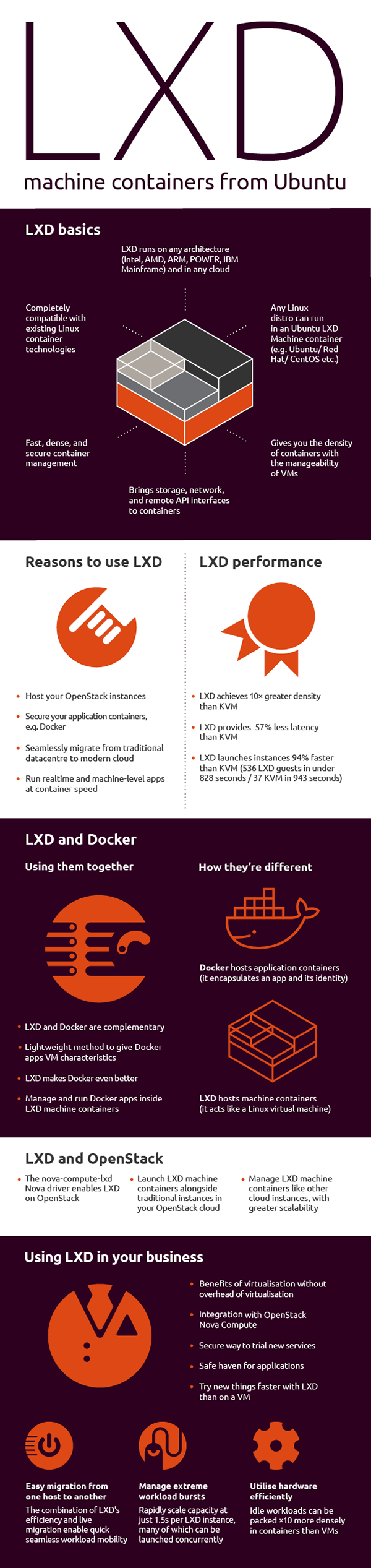
The infographic below introduces the basic facts about LXD, provides figures on LXD performance, explains how LXD and Docker work together and offers applications of LXD in your business.
Download datasheet OR Install LXD using the command line tool ›
Fast, dense, and secure container and VM management at any scale
LXD brings flexible resource limits, advanced snapshot and networking support, and better security — all making for easier, leaner and more robust containerised solutions and VMs.
Newsletter signup
Related posts
Canonical partners with Snyk for scanning chiseled Ubuntu containers
Canonical, the publisher of Ubuntu, is pleased to announce a new partnership with developer-focused cybersecurity company Snyk. Snyk Container, Snyk’s...
Introducing MicroCloud Cluster Manager
Canonical introduces the beta release of MicroCloud Cluster Manager, a new way to discover, organize, and operate your MicroCloud environments from a single,...
Native integration available between Canonical LXD and HPE Alletra MP B10000
Native integration available between Canonical LXD and HPE Alletra MP B10000. The integration combines efficient open source virtualization with high...